Why Google Cares More About Meaning Than Keywords Now
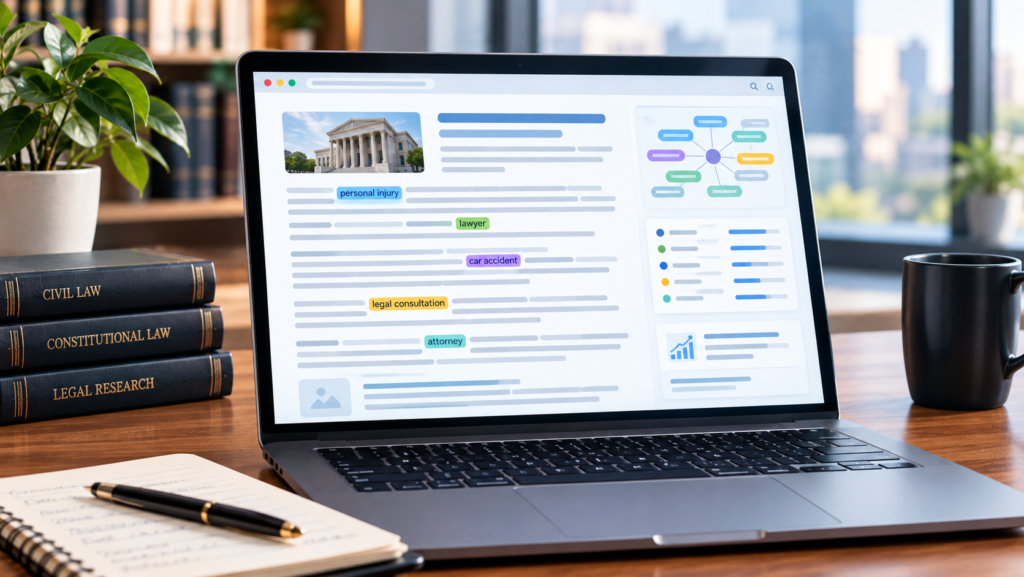
Semantic SEO is the practice of optimizing content around meaning, context, and topics, rather than matching exact keyword phrases. Instead of writing a page to rank for “divorce lawyer Atlanta” specifically, effective semantic SEO for law firms builds a page comprehensive enough to rank for the full range of related questions a prospective client might actually ask, using whatever words they happen to phrase it with. This especially matters for law firms specifically because legal questions rarely come in one exact phrasing, and both Google and AI search tools now reward content built around genuine topical depth over content built around a single target phrase.
From Matching Words to Understanding Meaning
Search engines didn’t always work this way. Early search algorithms matched the literal words on a page to the literal words in a search query, which is why older SEO advice focused heavily on keyword density and exact-match phrasing. Google’s Hummingbird update began shifting this toward understanding the intent behind a query rather than just its literal words, and later updates like RankBrain, BERT, and MUM pushed that further, allowing Google to interpret context, relationships between concepts, and increasingly complex, multi-part questions.
The practical result is that a search engine today isn’t just scanning for a keyword to appear on a page a certain number of times. It’s trying to understand what the page is actually about, who and what it references, and whether it genuinely answers the full scope of what someone searching that topic wants to know.
What “Semantic” Actually Means in Practice
At its core, semantic SEO revolves around a few connected ideas:
-
- Entities. An entity is any specific, identifiable person, place, organization, or concept, such as a specific attorney, a specific city, or a specific type of legal claim. Search engines map entities and the relationships between them, which is part of how they determine whether a page is a credible, authoritative source on a topic.
-
- Intent. Rather than matching words alone, search engines classify what a searcher actually wants: information, a specific business, or an action like scheduling a consultation. Content built around intent answers the actual need behind a search, not just its literal phrasing.
-
- Context and relationships. A page about “car accident settlements” that also correctly references related concepts, like insurance claims, comparative negligence, or medical liens, signals genuine topical depth in a way that a page narrowly focused on one exact phrase doesn’t.
Together, these are what allow a single well-built page to rank for dozens or even hundreds of related search variations, instead of requiring a separate page for every slightly different way someone might phrase the same underlying question.
Why This Matters More for Law Firms Specifically
Legal questions are naturally varied and often complex. Someone dealing with a legal issue might search “what happens if I get in an accident and it’s not my fault,” “do I need a lawyer for a minor car accident,” or “how long do I have to file a personal injury claim,” all of which reflect a related but differently phrased need. A page built narrowly around one exact keyword phrase misses the other two entirely. A page built with semantic SEO in mind, structured around the full topic rather than a single phrase, has a real chance at answering and ranking for all three.
This matters even more now because of how AI search tools operate. AI Overviews, ChatGPT, and similar tools aren’t matching a query to an exact keyword either, they’re evaluating whether a page comprehensively and clearly addresses the concept behind a question. Content built around genuine topical depth is inherently better positioned to be extracted and cited by these systems than content narrowly optimized around a single target phrase.
How Semantic SEO Changes What Content Should Look Like on Law Firm Websites
A page built with semantic SEO in mind looks different from one built around traditional keyword optimization:
-
- Comprehensive coverage over keyword repetition. Instead of repeating a target phrase throughout a page, the page addresses the full range of sub-questions a reader might have about the topic, using natural language rather than forced repetition.
-
- Natural use of related terms and synonyms. A page about “wrongful termination” that also naturally references related concepts, like at-will employment, retaliation, or severance, signals broader topical understanding than a page using only the exact target phrase.
-
- Consistent entity references. Using the firm’s name, attorney names, and location consistently and accurately throughout content helps search engines and AI tools confidently connect that content to the correct entity, rather than treating it as an ambiguous or generic mention.
-
- Direct answers to specific question variations. Since search intent varies in phrasing even when the underlying need is the same, addressing multiple realistic phrasings of a question within a single page, particularly in FAQ sections, captures more of that variation than a page built around one assumed phrasing.
Where Structured Data Fits In
Schema markup plays a direct supporting role in semantic SEO, since it explicitly labels entities and their attributes in a format search engines and AI systems can parse with certainty rather than inferring from unstructured text alone. Organization schema clarifies a firm’s identity, LocalBusiness schema clarifies location and service area, and FAQPage schema clarifies which content on a page is answering a specific question. None of this replaces well-written, comprehensive content, but it removes ambiguity about what a page’s content actually represents, which supports the same underlying goal semantic SEO is built around.
Practical Ways a Law Firm Applies This
A few concrete ways this shows up in an actual content strategy:
-
- Build practice area pages comprehensive enough to address the full range of related questions and concerns, rather than narrowly targeting one keyword phrase
-
- Use consistent, accurate naming for the firm, attorneys, and location across the entire site and across external directories, reinforcing a single, unambiguous entity
-
- Include FAQ sections that address multiple realistic phrasings of the same underlying question, not just one assumed version of it
-
- Use descriptive, natural internal link anchor text that reflects what the destination page is actually about, rather than generic phrases like “click here,” since this helps search engines understand the relationship between pages
-
- Apply schema markup consistently across practice area pages, FAQ content, and firm information to make entity relationships explicit rather than relying on search engines to infer them correctly
Frequently Asked Questions
Is semantic SEO the same thing as keyword research?
Not exactly. Keyword research identifies what terms people search for, while semantic SEO focuses on building content that comprehensively covers the topic and concepts behind those terms, which allows a single page to rank for many related variations rather than just the exact phrases researched.
Does semantic SEO replace the need for schema markup?
No, they work together. Semantic SEO is the broader content and topical strategy, while schema markup is a technical tool that makes entities and relationships within that content explicit and easier for search engines and AI systems to parse accurately.
How does semantic SEO affect a law firm’s visibility in AI search tools?
AI search tools evaluate whether content comprehensively and clearly addresses the concept behind a question, rather than matching an exact keyword phrase. Content built with semantic SEO principles, covering a topic broadly and using consistent entity references, is generally better positioned to be extracted and cited by these tools than narrowly keyword-focused content.