

How Much Does Law Firm SEO Cost?
Legal SEO Agencies Offer A Variety of Services At A Variety Of Prices, So How Much Should Law Firm SEO Cost Your Firm?
If you want a number to anchor to, a reasonable starting point is 5% to 10% of your firm’s annual revenue directed toward digital marketing specifically. But that range alone doesn’t tell you much, because the price tag alone doesn’t tell you whether an SEO engagement is actually worth what it costs. Two firms spending the exact same percentage of revenue can get completely different results, because the number reflects almost nothing about the quality, depth, or strategy behind the work. The real question isn’t what percentage to spend. It’s what that spend is actually buying you, and whether it scales the way it should as the number goes up.
What You’re Actually Paying For
SEO pricing covers a mix of things: content creation, technical optimization, backlink outreach, local search management, and strategic oversight. The problem is that these components can vary enormously in quality and depth while still being described with the same generic labels on two different proposals. “Monthly blog content” can mean a thoughtfully researched, practice-area-specific article built around real search intent, or it can mean a templated, generic post produced as quickly as possible to hit a quota. Both get called “content” on an invoice. Only one of them is actually worth paying for.
This is why comparing SEO pricing across providers by looking at the price alone is close to meaningless. The number tells you what you’ll spend. It tells you almost nothing about what you’ll get.
Why Two Firms Can Pay the Same Price and Get Wildly Different Results
A firm paying a mid-range monthly rate to a generalist provider serving dozens of unrelated industries is often getting a fundamentally different service than a firm paying that same rate to a provider specializing specifically in legal marketing. The generalist provider is applying a broad, one-size-fits-most approach across plumbers, dentists, and law firms alike. The specialist is applying deep knowledge of legal search behavior, bar association advertising rules, and practice-area-specific client psychology to every decision.
Same price. Genuinely different depth of work behind it. This is the gap that a price comparison alone will never reveal, and it’s usually the single biggest factor separating SEO that actually moves the needle from SEO that just generates activity.
Watch for Outsourced and White-Labeled Work
One of the least disclosed factors affecting SEO pricing is whether the agency you’ve hired is actually the one doing the work. A lot of firms charging competitive, professional-sounding rates are quietly outsourcing the actual content writing, technical work, or link building to low-cost overseas teams or third-party white-label providers, then marking that work up and presenting it to the client as their own.
This matters for a few concrete reasons:
- Legal content requires jurisdiction-specific accuracy and nuance. A generic overseas content team producing law firm blog posts at scale often lacks real familiarity with how legal concepts, terminology, and client concerns actually work in a specific U.S. state or practice area, which shows up as content that reads technically correct but subtly generic or occasionally inaccurate.
- Accountability gets diluted. When the agency you’re paying isn’t the one actually doing the work, there’s an extra layer between you and the people responsible for quality, which makes it harder to get specific answers, request meaningful changes, or hold anyone accountable when something underperforms.
- You’re paying a markup for a layer of oversight that may not exist. The price difference between what a client pays and what an overseas or white-label team is actually paid often reflects the agency’s margin, not additional strategy or expertise layered on top of the work.
- Quality control becomes inconsistent. Work produced by a rotating pool of outsourced freelancers or a white-label vendor juggling dozens of unrelated agency clients tends to be far less consistent in voice, quality, and strategic alignment than work produced by a dedicated in-house team that actually knows the firm and its market.
This is worth asking about directly and specifically, since it’s rarely volunteered upfront: is the work actually performed in-house by the team you’re speaking with, or is it outsourced to a third party and presented under the agency’s name? A firm paying a premium rate assuming in-house expertise, while actually receiving outsourced, white-labeled work, is paying for something it isn’t getting.
How to Tell Quota From Strategy
This is the distinction that actually matters more than the price itself. A few signals separate the two:
Signs of quota-driven work:
- Reports that show activity metrics, like number of posts published or backlinks built, without connecting any of it to leads, calls, or signed cases
- Content that reads generically, with little specific reference to the firm’s actual practice areas, location, or client base
- The same cadence and deliverables month after month, regardless of what’s actually working or not working
- Little to no explanation of why specific keywords, topics, or technical changes were prioritized over others
Signs of genuine strategy:
- Reporting tied directly to qualified leads and signed cases, not just traffic or content volume
- Content and technical priorities that shift based on what’s actually performing, rather than following a fixed template regardless of results
- Clear, specific reasoning behind keyword and content decisions that reflects the firm’s actual practice areas and competitive market
- A provider who can explain what they’re doing and why in plain language, rather than pointing to a vague monthly report as proof of value
Quota-driven work can look busy and even produce a reasonable-looking report every month while quietly failing to generate real business results. Strategy-driven work might sometimes look like less activity on paper, but it’s activity aimed specifically at the outcomes that actually matter.
The Real Test Before You Sign
Rather than asking what a provider charges, a more useful set of questions gets at what that price is actually buying:
- What specifically expands if I move to a higher tier, beyond just more of the same content type?
- Who on your team will actually be handling my account, and how many other clients are they managing?
- Can you show me how a specific past decision, a keyword choice, a content topic, a technical change, connected to an actual result?
- How do you decide what to prioritize each month, and how does that change based on performance?
A provider who can answer these clearly and specifically is very likely doing strategic work. A provider who deflects into generic language about experience and results without specifics is often selling quota dressed up as a strategy.
Frequently Asked Questions
Does paying more for SEO always mean better results?
Not automatically. Higher cost only translates into better results when the additional spend genuinely buys more expertise, more strategic oversight, and more variety in the work, rather than just a larger volume of the same narrow deliverables.
How can a firm evaluate an SEO proposal without just comparing prices?
Ask what specifically differs between pricing tiers beyond content volume, who will be handling the account and their relevant experience, and how success will be measured and reported. These questions reveal far more about actual value than the price alone.
Is a lower-priced SEO provider automatically a worse choice?
Not necessarily, but it’s worth scrutinizing what’s included at that price point just as closely as a higher-priced option. A lower price paired with genuine specialization and transparent, results-based reporting can outperform a higher price spent on generic, quota-driven work.

Why Page Load Speed Is Costing Your Law Firm Clients (And How to Fix It)
A slow law firm website speed loses clients twice. First, a slow load time makes your site harder to find in the first place, because page speed is a confirmed
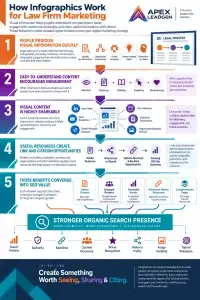
6 Reasons Why Infographics Are Essential For Law Firm Digital Marketing Content Strategies
Why Infographics May Be One Of Your Most Important Assets For Law Firm Digital Marketing Infographics help law firms turn complex legal information into content that is easier to understand,

What Is Crawl Budget, and Why Does It Matter for Law Firm SEO?
Crawl budget is the number of pages Google’s crawler is both able and willing to spend time on during a given visit to your site. On a lean, well-maintained site,

Restaurant-Style Booking for Law Firms: 5 Habits Worth Stealing
What Law Firm Owners Can Learn From Restaurant Reservation Systems Law firm online scheduling works best when it borrows from restaurants: instant booking, automatic reminders, a smart waitlist, guest notes,

Spanish SEO For Law Firms: 4 Unique Strategies To Land More Cases
Marketing Ideas For Lawyers That Win Spanish Speaking Clients The best way to market your law firm to Spanish speaking clients is to build a real Spanish-language channel with its